Notes from the studio
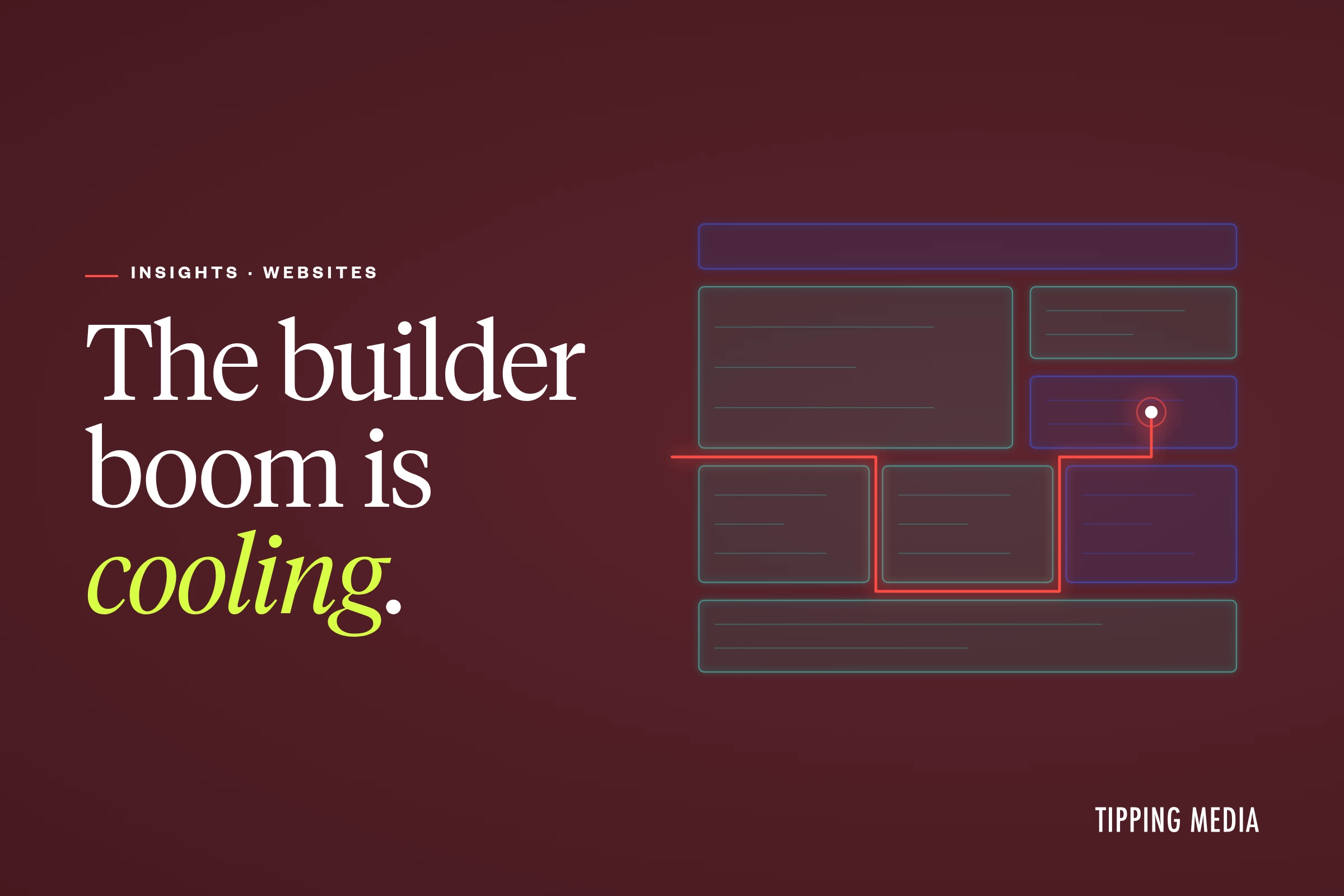
The AI website builder boom is cooling. Here's what it taught us about websites.
AI website builders made a decent-looking website fast and cheap. That boom is starting to cool, and the reasons say a lot about what a website is really for.

Brian Kaufman
Co-Founder + Head of Strategy
· 5 min read
On this page
By Brian Kaufman, Co-Founder + Head of Strategy, Tipping Media. Brian has spent nearly 20 years in digital media, helping organizations bring their brand, message and technology back into alignment.
For most of the last year and a half, the fastest way to get a website was to describe one to an AI tool and let it build the thing. That idea caught on fast. It's also starting to cool, and the reasons say a lot about what a website is really for.
The spike, and the cooldown
Search interest tells the story. "ai website builder" now gets about 110,000 searches a month worldwide, about 33,100 of them in the US (RankDude, AI Website Builder Statistics, Sept. 2026, from Google Ads data). Google Trends barely registered the term until June 2025. Interest peaked at 55 out of 100 in August 2026 and sits at 24 now (same source).
Traffic is moving the same way. The 40 AI website builder sites RankDude tracks got about 15.7 million visits from Google search in September 2026, 26% fewer than a year earlier. Wix and Squarespace together take 69% of those visits (RankDude).
That doesn't mean people have stopped asking about websites. A May 2026 Ahrefs analysis by Pronto Marketing found "best website builder for small business" at 6,500 US searches a month, "how much does a website cost" at 2,900 and "can AI build a website" at 400 and rising (Pronto Marketing).
So the questions are still there. The excitement has worn off. That's usually the point where the useful lessons show up.
What the builders got right
Give the tools their due. AI builders made a decent-looking website fast and cheap. A small business, a new nonprofit program or a side venture can now have a clean page up in an afternoon. For a lot of situations that's the right answer. Anyone who tells you otherwise is selling something.
They also changed what people expect. Nobody should have to wait three months for a simple site anymore. The bar for speed went up, and that's good for everyone, agencies included.
What they couldn't do
A builder can arrange words and images well. It can't decide what those words should say. In our experience, that's where most websites fall short. The problem is rarely the template. It's the message underneath it.
Four gaps keep coming up.
1. Clarity about who you serve. A website works when a visitor can tell within seconds whether it's for them and what to do next. That depends on being clear on who you serve and what makes you different. If that thinking hasn't happened, the AI fills the gap with polished, generic copy that sounds like everyone else.
2. Being found. Searchers are focused on visibility. "Local SEO for small business" is the top marketing query in Pronto's dataset at 3,500 US searches a month and rising, while "how to advertise my business" sits at 400 and is declining (Pronto Marketing). A good-looking site that search engines and AI tools can't understand doesn't help much.
3. Showing up in AI answers. More buyers now start with ChatGPT, Google's AI Mode or Perplexity. In a Semrush study of 89,000 LinkedIn URLs cited by those tools, about 95% of cited posts were original, and reshares made up only about 5% of citations (Semrush). The pattern is consistent: AI tools cite original, useful thinking. A site assembled from the same patterns as thousands of others gives them very little to cite.
4. A clear next step. Plenty of websites look finished and still don't lead anywhere. Someone has to decide the one action that matters most (visit, give, book, call) and design every page around it. That's a judgment call about your organization, not a layout setting.
One more reason to own your website
This month brought a reminder that the website is the one channel you fully control. Meta's updated Commercial Terms, now set to take effect Nov. 20 (pushed back from Oct. 30) (Search Engine Journal), let it crawl websites associated with businesses that use its products, including businesses that only run a Facebook Page and buy no ads. After pushback, Meta removed "train" from the clause's listed uses on Oct. 19 but kept the crawl permission (Search Engine Journal). Meta has pointed to robots.txt as the way to control access.
This isn't a reason to panic. It's a reason to know what's on your site, check how your robots.txt treats each crawler and make sure the content you own says what you actually mean.
A realignment checklist for your website
Whether you're using a builder or a full custom build, these questions decide if a website does its job:
Who is this for? Name the two or three audiences that matter most, in plain language.
What should they do next? Pick one primary action and make it obvious on every page.
What do you believe? Put your point of view in writing. It's what makes you citable by people and by AI.
Can you be found? Get the basics right: a Google Business Profile, clear page titles, structured content and accurate location details where they matter.
Do you own it? Know where your content lives, who can edit it and which crawlers can reach it.
Can your team keep it current? A site that's hard to update falls out of date, whatever tool built it.
When DIY is enough, and when it isn't
If you need a simple presence quickly, your message is already clear and the stakes are low, an AI builder is a reasonable choice. Use it well.
If your organization has changed, you serve several audiences, people describe you in different ways or your site isn't producing results, the tool won't fix that. The problem is alignment, not software. That's when an outside perspective pays for itself, to sort out the message first and then build a website that does its job.
The builder boom made websites easy to make. What still takes work is knowing what your website needs to say.
If your website no longer reflects where your organization is headed, let's talk it through. → Start a conversation
Brian Kaufman
Co-Founder + Head of Strategy
Tipping Media
Brian helps organizations realign their strategy, brand, marketing and technology so they can move the right work forward.