Notes from the studio
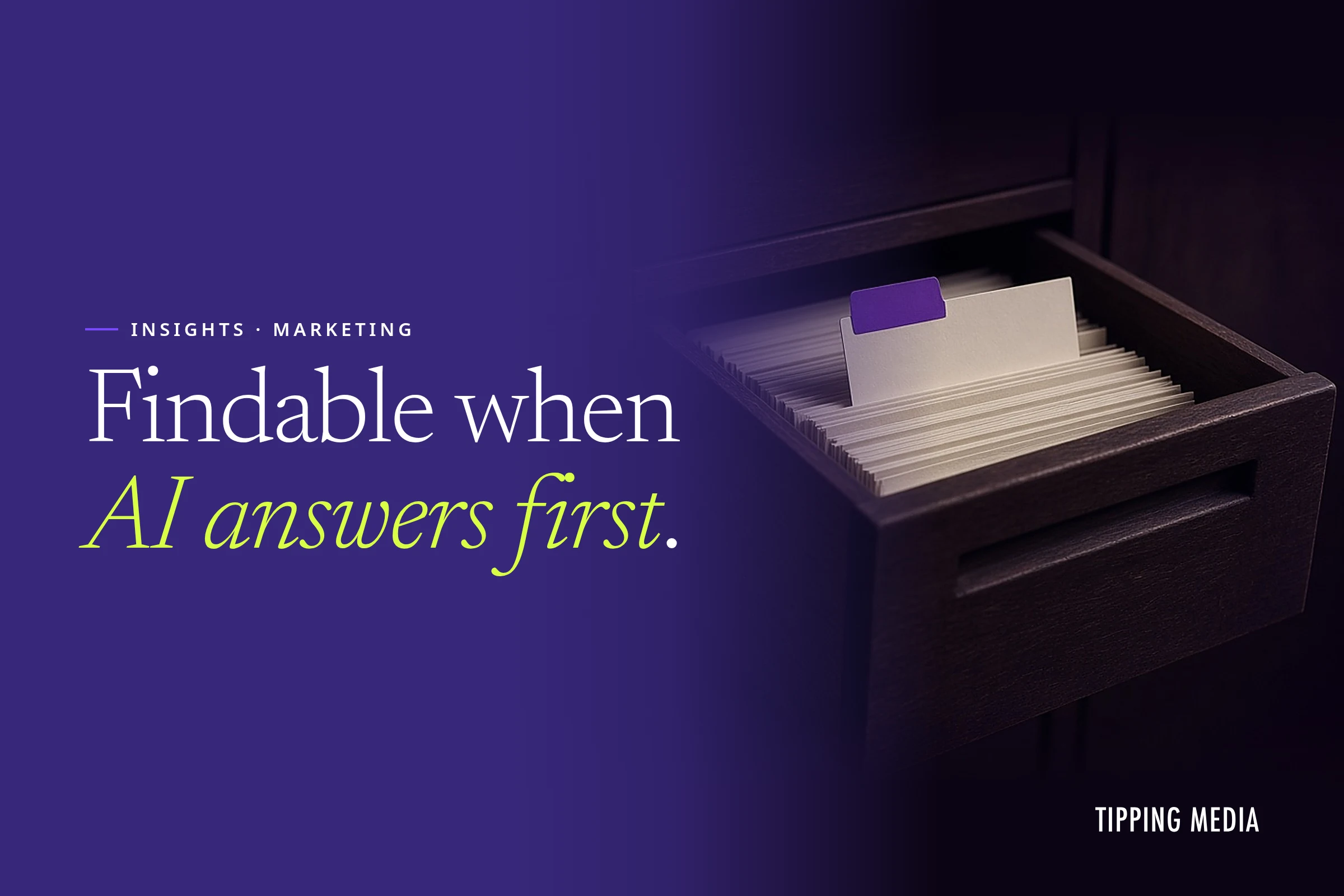
How to Stay Findable When AI Answers First
More people meet your organization inside an AI answer before they ever reach your website. The good news is that the fundamentals still decide who gets linked. Five checks to run before you buy anything new.

Brian Kaufman
Co-Founder + Head of Strategy
· 6 min read
On this page
By Brian Kaufman, Co-Founder + Head of Strategy at Tipping Media
This fall, a lot of AI search advice has started to sound like a product pitch. An article about "generative engine optimization" gets forwarded around the office. A vendor offers an AI visibility package. Suddenly it feels like the website needs something new to survive AI search.
Usually it doesn't need something new. It needs the basics done well, on purpose.
Here's what changed, what didn't and five checks I'd run before spending money on anything.
What changed this fall
Three things moved in the last few months, and together they make AI search less of a black box.
Google is putting more links inside its AI answers. On October 15, Google said it had made "continued and substantial increases" to inline links in AI Mode and AI Overviews and is showing them higher in responses more often. It's also testing a section at the top of some answers for cases where "there are only one or two official places on the web to complete a specific task" (Google, Oct. 15, 2026). If someone asks how to start working with an organization like yours, Google wants to send them to the official page.
You can now see some of it. Search Console's generative AI performance report, available to all sites worldwide since August 31, shows how often links to your site appeared in AI Overviews and AI Mode, by page, country and device (Search Console Help). Bing added a Topics Portfolio view in October that groups the AI answers your site is cited in by theme and lists "opportunity queries" where other sites are cited and yours isn't (Bing Webmaster Blog, Oct. 13, 2026).
Buyers are reading your thinking through AI. In the new Edelman and LinkedIn B2B Thought Leadership Impact Report, a survey of more than 1,100 executives in seven countries, 84% of B2B decision-makers said they used AI to summarize thought leadership while evaluating vendors (Edelman, Nov. 9, 2026). Your website and what you publish are being read, summarized and passed along by software before a person decides to call.
What didn't change
Google's own guidance is plain about this. There are "no additional requirements to appear in AI Overviews or AI Mode, nor other special optimizations necessary." To be shown as a supporting link, a page has to be indexed and eligible to appear in Search with a snippet. Google also says you don't need "new machine readable files, AI text files, or markup," and there's no special schema to add (Google Search Central).
That's worth sitting with before you buy anything. The organizations that show up in AI answers are mostly the ones that were already clear, crawlable and useful. AI search raised the cost of being vague. It didn't invent a new rulebook.
Five checks to run this month
None of these needs a new tool. Most need an hour and someone who knows your site.
1. Make sure your main point is actually on the page
Read your homepage the way a crawler does. Google lists "making sure that important content is available in textual form" as a basic best practice. If your headline lives inside an image, a video or a script that loads after the page, some systems may never see the one sentence that explains what you do. Ask your web team to check the HTML your server sends, not just what the browser shows. In Search Console, the URL Inspection tool shows what Googlebot received.
2. Check that you aren't hiding from the answers by accident
The quiet problems are the common ones. A robots.txt rule, a CDN setting or a leftover snippet control can keep a page out of AI features. Google names the controls that limit what it shows: nosnippet, data-nosnippet, max-snippet and noindex. Those are useful when you mean them. On your most important pages, confirm nobody set one by mistake. AI training is a separate switch from search. On October 30, Google, Microsoft, OpenAI and Anthropic backed one shared robots.txt option for stating an AI training preference (Google Search Central, Oct. 30, 2026). Decide each one on purpose.
3. Answer one question near the top of each key page
Inline links sit next to the claim they support. That favors pages that answer a real question in plain language early, rather than pages that warm up for three paragraphs. Pick your five most important pages and write down the one question each should answer. Then check whether the first two sentences answer it. This is the same discipline we use in a website redesign: decide what each page is for before you design it.
4. Be the obvious official page for your own name
Google is testing a way to surface the official page when only one or two sources matter. For your organization, that's your site. Make sure the pages people need most are easy to find and say what they're for: what you do, who you serve, how to start and how to reach a person. Google's guidance also mentions keeping your Business Profile and Merchant Center information up to date. If your own site is vague, an AI answer will lean on whatever else it can find about you.
5. Publish something worth quoting
This is the one no tool can do for you. In the Edelman report, 56% of B2B decision-makers said the thing that does most to raise their trust in a company is showing a clear understanding of their challenges, priorities and constraints. Only 14% said showing the strength of its products or services. AI can summarize an argument. You still have to make one. A clear point of view, in your own words, is the most durable thing you can put on your site. If your team can't agree on what that point of view is, a messaging reset comes first.
Measure what you can and ask the rest
Start with what's free. Open the generative AI performance report in Search Console and see which pages appear. If you use Bing Webmaster Tools, look at the AI Performance report and its Topics view. Treat both as directional. Bing labels Topics a beta and calls its numbers "directional signals for planning, not as a precise ledger."
Then add the simplest measure of all. Ask new inquiries how they found you, and include "an AI tool like ChatGPT, Gemini or Google's AI Mode" as an option. It costs nothing and tells you something no dashboard will.
What to skip
Be careful with anything sold on the strength of a new name. Search interest in "generative engine optimization" in the US is down about 24% from its October 2025 peak, according to an analysis of Ahrefs data by Something Inc. (Sept. 2026). The work is real. The label is still settling. You don't need an AI text file, special schema or a new platform to be eligible for Google's AI features, because Google says so in its own documentation.
We saw the same pattern with AI website builders. The tools made things faster. They didn't make anyone clearer.
How we help
Being findable in AI search is part of our Marketing & Growth work, which includes SEO and AI search visibility. We usually start with an Alignment Review: we read your site the way a buyer and a crawler would, check the technical basics above and look at whether your message is clear enough to quote. Then we fix what matters most, in order.
Brian Kaufman
Co-Founder + Head of Strategy
Tipping Media
Brian helps organizations realign their strategy, brand, marketing and technology so they can move the right work forward.